

























































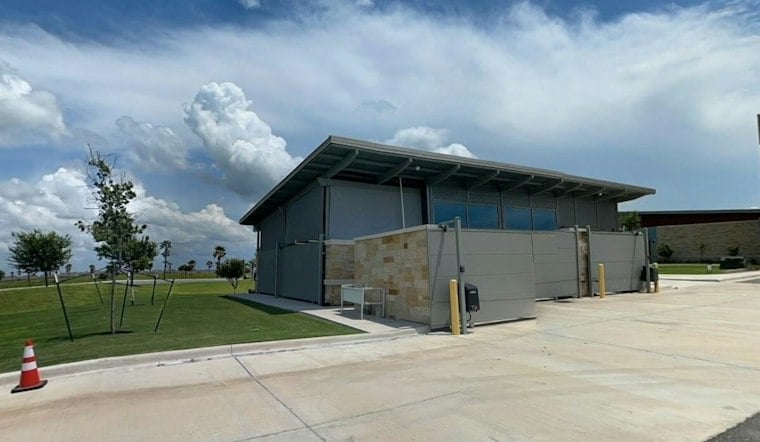
The Texas A&M University System Board of Regents has approved construction of a $50 million Health Education and Research Building on the McAllen campus, a three-story facility that will house classrooms, clinical labs and library space for a student population that has exploded in size over the past year. Construction is expected to begin in December 2026.
The regents' approval, detailed in a Texas A&M University System announcement, calls the new building a three-story, 49,400-square-foot facility, though a separate project listing from a state procurement posting describes it as a 48,347-gross-square-foot facility. The project is paid for with $25 million in state appropriations and $25 million from the system's Available University Fund, and regents have now appropriated the full $45 million needed for construction, bringing total appropriations for the project to the complete $50 million.
As KRGV first reported, construction is scheduled to start next month, and university leaders expect the project to be finished in about two years. The system's own timeline pegs completion at November 2028, with students and faculty expected to move in by January 2029.
A Campus Outgrowing Its Space
The expansion comes as the McAllen campus has seen a rapid jump in students. Executive Director Will Wynn told the station, “Just in the last year, our student body has grown by 30%. So we're up to 650-plus students now.” The new building is intended to give that growing population more room, with classrooms and labs dedicated to the campus's pharmacy technician program alongside broader research space focused on health and education issues in the Rio Grande Valley, per the station's report.
The McAllen campus has offered its Aggie Pharmacy Technician Program since 2023, and the new structure will formalize and expand that offering, according to the system. The Texas A&M University Health Science Center will run the completed building, which is planned to include flexible classrooms, teaching labs, a clinical skills lab for pharmacy students, faculty offices, a library, a testing center, a makerspace and an innovation studio.
Third Building On a Growing Campus
Project documents from the Texas A&M System's Office of Facilities Planning & Construction describe this as the third building at the McAllen Campus, with space planned to support the campus broadly as well as Texas A&M Libraries, the School of Pharmacy and the School of Public Health. Alamo Architects is listed as the project's architect and engineer, while SpawGlass Construction, Inc. is named as general contractor, with subcontractor bidding scheduled for fall 2026.
This new building is distinct from two other Texas A&M projects already underway or completed nearby in McAllen. A separate Nursing Education and Research Building, reported by myRGV to cost $49.9 million and cover 61,000 square feet, is meant to house the College of Nursing and the College of Veterinary Medicine & Biomedical Sciences' One Health Hub. Another planned AgriLife research center, budgeted at $53.5 million according to the Rio Grande Guardian, is reported at either 43,500 or 43,000 square feet depending on the outlet, and is a separate project from the new health education building.
Why the Valley Needs More Health Training
The push to expand health education capacity in the Rio Grande Valley comes against a backdrop of looming physician shortages across South Texas. A study published by ScienceDirect projects that by 2032, vascular surgery and nephrology will have the first- and fourth-worst physician shortages in the state, respectively, with only 42.3% to 58.4% of the Rio Grande Valley's need for those specialists expected to be met. The same research notes that Texas had the nation's highest rates of end-stage renal disease between 2016 and 2020, with its border regions leading the state.
Those workforce gaps underscore the stakes behind the new McAllen facility's mission to train pharmacy technicians and support public health research in the region. The building's clinical labs and research space are designed to feed into a health workforce pipeline that regional data suggests is falling behind demand, even as the broader scope and pace of that shortage remain the subject of ongoing study.



